


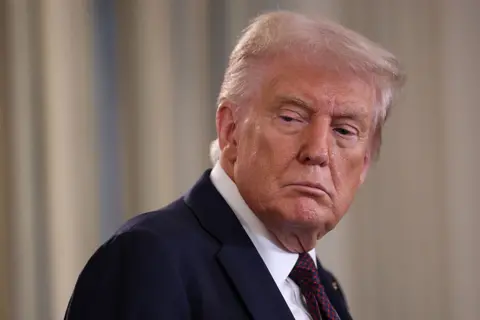
Our nation's judicial body starts its current docket this Monday with a agenda currently packed with potentially major cases that could establish the extent of executive presidential authority – along with the possibility of additional issues to come.
Over the past several months after the administration was reelected to the Oval Office, he has pushed the boundaries of governmental control, independently introducing recent measures, slashing public funds and workforce, and attempting to place previously autonomous bodies more directly within his purview.
Judicial Battles Concerning State Troops Deployment
A recent brewing court fight originates in the administration's attempts to assume command of state National Guard units and send them in urban areas where he claims there is public unrest and widespread lawlessness – despite the objection of regional authorities.
Across Oregon, a US judge has delivered directives blocking Trump's mobilization of military personnel to the city. An appellate court is scheduled to examine the move in the near future.
"Ours is a country of judicial rules, instead of military rule," Magistrate the presiding judge, who the administration appointed to the judiciary in his previous administration, wrote in her recent ruling.
"Defendants have presented a range of claims that, should they prevail, risk erasing the boundary between civil and armed forces federal power – undermining this republic."
Expedited Process Might Determine Military Authority
After the appellate court makes its decision, the Supreme Court may step in via its often termed "emergency docket", delivering a judgment that could restrict executive authority to use the military on US soil – alternatively give him a wide discretion, at least temporarily.
This type of reviews have turned into a increasingly common practice lately, as a larger part of the Supreme Court justices, in reply to expedited appeals from the White House, has largely permitted the administration's measures to proceed while judicial disputes progress.
"A tug of war between the Supreme Court and the lower federal courts is set to be a major influence in the coming term," a legal scholar, a instructor at the University of Chicago Law School, stated at a conference last month.
Concerns Over Shadow Docket
Justices' use on the emergency process has been criticised by left-leaning experts and officials as an improper use of the legal oversight. Its orders have often been brief, providing minimal justifications and providing lower-level judges with scarce guidance.
"Every citizen must be worried by the Supreme Court's growing dependence on its expedited process to resolve disputed and high-profile disputes absent the usual transparency – minus detailed reasoning, public hearings, or reasoning," Democratic Senator the lawmaker of New Jersey stated previously.
"It more pushes the Court's deliberations and rulings out of view civil examination and insulates it from answerability."
Full Reviews Approaching
Over the next term, though, the court is set to address questions of governmental control – along with additional notable disputes – squarely, conducting public debates and delivering complete rulings on their basis.
"It's not going to get away with one-page orders that don't explain the rationale," said an academic, a expert at the prestigious institution who specialises in the High Court and political affairs. "If they're going to provide expanded control to the administration they're must clarify the reason."
Significant Cases within the Schedule
The court is currently scheduled to examine whether federal laws that bar the president from dismissing officials of institutions designed by the legislature to be independent from White House oversight infringe on executive authority.
Court members will also hear arguments in an accelerated proceeding of the President's effort to remove Lisa Cook from her role as a official on the prominent monetary authority – a dispute that could significantly increase the chief executive's authority over US financial matters.
America's – plus world economy – is further a key focus as judicial officials will have a occasion to rule whether a number of of the administration's unilaterally imposed tariffs on international goods have adequate regulatory backing or should be voided.
Judicial panel could also examine the President's efforts to unilaterally reduce government expenditure and terminate subordinate public servants, in addition to his aggressive immigration and removal policies.
Although the judiciary has not yet decided to consider the President's attempt to abolish automatic citizenship for those delivered on {US soil|American territory|domestic grounds


